History, traditional knowledge and dedication do not only belong to the past: in order to meet today's new challenges, from environmental sustainability to the problems of climate change and drought, the world of wine is also aiming at the reintroduction of ancient winemaking techniques in a modern key.
This is what is being done by the Librandi winery - the leader of the Calabrian oenological renewal - which next Saturday, 29 March, will illustrate the experiments underway and the results obtained at a conference.
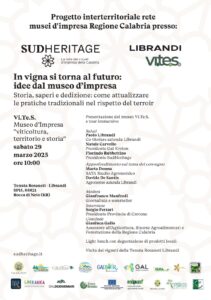
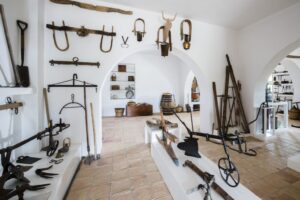
The appointment is at 10 a.m. at Tenuta Rosaneti (in the countryside of the municipality of Rocca di Neto) in the premises of the Vi.te.s. Museum - 'Viticulture, Territory and History', which is part of the 'SudHeritage' Network of Calabria Museums.
During the conference, which will begin with the presentation of the company museum with its new acquisitions and an immersive tour of the estate, there will be an important 'focus' introduced by Paolo Librandi, co-owner of the company, Natale Carvello, President of Gal Kroton and Florindo Rubbettino, publisher and President of the SUDHERITAGE museum network.
This will be followed by an in-depth discussion that will focus on the theme of the event. Speakers will be Marta Donna, of the Brescia-based 'SATA Studio Agronomico' and Davide De Santis, head of the Librandi agronomic staff.
How to cope with climate change in the South and in an area such as the Cyrrhane, where water scarcity and scorching temperatures are nothing new? How to help vines adapt to thirst and high temperatures?
In the Librandi vineyards, there is a return to traditional pruning and natural fertilisation with the technique of green manure (field beans, white mustard, turnip rape, clover), to grafting vines in the field, and to proper water regulation to deal with extreme weather phenomena that have now become endemic.
The results pursued are evaluated by permanently monitoring the healthiness of the soil with measurements and cores.
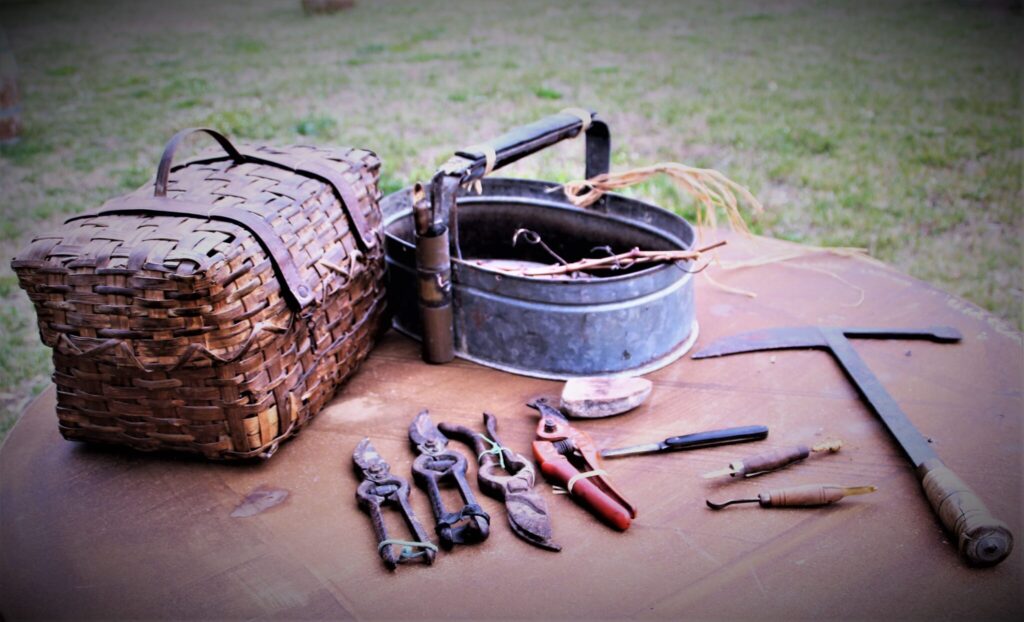
More generally, there is a revival of manual skills, the recovery of traditional practices and the 'philosophy' of old tools that had been abandoned. A return, in short, non-nostalgic but aware of the need to address in a 'natural' way the new problems related to climate change (temperatures, drought, soil 'consumption', etc.) and the pollution of chemical interventions in agriculture and also in the vineyards.
The multi-voice debate, moderated by the journalist Gianfranco Manfredi, will also include a speech by the President of the Province of Crotone, Sergio Ferrari, and, finally, the conclusions of Gianluca Gallo, Calabria Region's Councillor for Agriculture, Agrifood Resources and Forestry.
Back to the future' is not a far-fetched oxymoron. Not least because many tools on display in the Librandi company museum, which have been obsolete for decades, are back in use in today's vineyards...
After all, behind the dynamics at the centre of the 29 March conference are the research and experiments that the Librandi winery has been engaged in for some thirty years. A large-scale, multidisciplinary study promoted by the company has ascertained that Calabria possesses one of the most important wine-growing platforms in the world. Considered by many scholars to be a land of passage for the spread of vine cultivation in Europe, the region has preserved traces of it still alive.
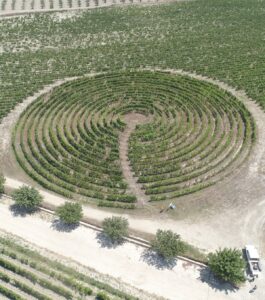
In 2003, the Librandis created a varietal garden of 2800 'new-antica' vines, arranged in a spiral, in order to include the entire collection of harvested vines.
They carried out a very detailed project (DNA study, ampelographic and virological analysis) and oenological research on these varieties. Thus it was discovered, with the DNA survey carried out by the San Michele all'Adige Institute, that of 126 varieties analysed, as many as 77 were found to be unique, i.e. not traceable to varieties already known and catalogued.
Recent experience is revealing that the oldest indigenous grape varieties show a remarkable capacity for resistance and adaptation to climatic stresses.
The iconic spiral vineyard is, in many ways, a 'living bridge' between the distant past and the future of oenology.